

What a 56-Point Inspection Actually Checks, and Why Veterans Get One on November 11
November 10, 2026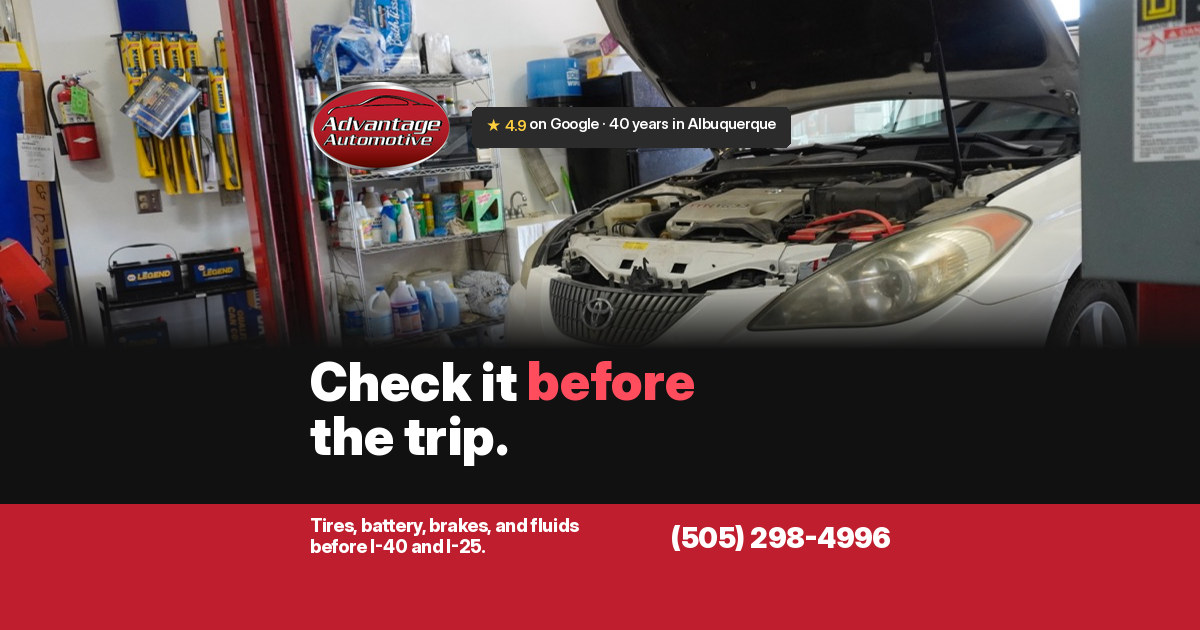
Thanksgiving week puts more Albuquerque families on the interstate than any other week of the year, and it does it right as the weather turns. A vehicle that handles a twelve-mile commute without complaint is about to be asked for four hundred miles at highway speed, fully loaded, over a mountain pass, in temperatures it has not seen since February. Most holiday breakdowns are not surprises. They are small problems that were already there, waiting for a long day to finish them.
- Long highway miles expose weak tires, batteries, belts, and cooling systems that survive short trips around town
- Every route out of Albuquerque climbs, and cold, altitude, and a full load all work against a marginal part
- A trip inspection a few days before you leave turns a roadside failure into an ordinary appointment
Why a Road Trip Finds What a Commute Hides
Around town, your vehicle works in short bursts. The engine warms up, runs for fifteen minutes, and rests. A weak water pump, a belt with cracks across its ribs, or a tire with a slow leak can live that way for months. A highway trip removes the rests. The engine holds operating temperature for hours, the transmission stays loaded, the tires build heat mile after mile, and the charging system runs the heater, the defroster, the lights, and every phone in the car at once.
Weight matters as well. Four adults, luggage, and a cooler can add six or seven hundred pounds. That load lengthens stopping distance, raises tire temperature, and asks more of shocks and brakes that may already be near the end of their service life. Nothing about this is hard on a healthy vehicle. It is only hard on the part that was already on its way out.
Every Road Out of Albuquerque Goes Up
Geography makes the case for us. Head east on I-40 and you climb through Tijeras Canyon within minutes of leaving town, then cross open plains to Santa Rosa and Tucumcari, where the wind has nothing to slow it down. Head west and you gain elevation toward the Continental Divide on the way to Gallup and Flagstaff. North on I-25 means La Bajada Hill before Santa Fe and, for anyone bound for Colorado, Raton Pass at more than 7,800 feet. Even the run south to Las Cruces includes long stretches with very little between exits.
Late November adds cold to the climb. A battery that cranked well enough in a 50 degree garage has far less to give at 15 degrees in a motel parking lot in Raton. Tire pressure falls about one pound per square inch for every ten degree drop in temperature, so a tire that was a little low in Albuquerque is noticeably low by the time you reach the pass. Coolant that has not been tested in years may not protect to the temperatures you will see overnight in northern New Mexico or southern Colorado.
What a Trip Inspection Covers
A trip inspection is a structured walk through the systems that strand people. It is not a sales exercise, and most vehicles pass most of it. The value is in the one or two items that do not.
- Tires: tread depth across the full width, wear pattern, sidewall condition, age, and pressure, including the spare
- Battery and charging: a load test, clean and tight terminals, and alternator output
- Belts and hoses: cracks, glazing, soft spots, and seepage at the clamps
- Fluids: engine oil, coolant strength, brake fluid, transmission fluid, and washer fluid rated for freezing weather
- Brakes: pad thickness, rotor condition, and a firm pedal
- Steering and suspension: shocks, struts, tie rod ends, and ball joints
- Lights and wipers: every exterior bulb, blade condition, and working defrosters front and rear
The spare deserves its own mention. Many drivers have never looked at theirs, and a compact spare can lose most of its pressure over a few years of sitting in the trunk. Some newer vehicles carry no spare at all, only a sealant kit. It is better to learn which one you have in our parking lot than on the shoulder east of Clines Corners.
The Cost of Finding Out on the Road
A repair made before a trip is made on your schedule, at your shop, with time to explain what was found and why it matters. The same repair made on the road comes with a tow, a shop you did not choose, whatever parts that town has on the shelf, and often a night in a hotel while the family waits. A serpentine belt is a routine job in Albuquerque. On a Wednesday night before Thanksgiving in a small town along I-40, it can cost you the holiday.
There is a safety side to this as well. A tire failure at 75 miles per hour, a brake pedal that goes soft on a long downgrade, or wipers that smear instead of clear in a snow squall are different in kind from an inconvenience. The inspection exists to catch those before they have a chance to happen.
Timing It Right
Schedule the inspection several days ahead of your departure, not the afternoon before. If we find a worn belt or a battery at the end of its life, we need time to get the right part and install it properly. A few days of margin also lets you drive the vehicle after any repair and confirm that everything feels right before you load it up.
Before you leave, do your own short walk around as well. Check that all the lights work, top off the washer fluid, set the tire pressures to the number on the driver’s door jamb while the tires are cold, and put a blanket, water, a flashlight, and a phone charger in the car. Winter weather on Raton Pass or in Tijeras Canyon can stop traffic for hours, and those four items make the wait far easier.
Leave With Confidence
If you are driving for Thanksgiving, give your vehicle the same attention you give the route and the menu. Call (505) 298-4996 to schedule a trip inspection at Advantage Automotive. We will show you what we find and tell you plainly what needs attention before you go and what can wait until you are home. Repairs are backed by our NAPA AutoCare Gold 36-month, 36,000-mile nationwide warranty, which travels with you wherever the holiday takes you.
Advantage Automotive
511 Paisano St. NE
Albuquerque, NM 87123
(505) 298-4996

