
Why Getting a Second Opinion on Vehicle Repairs Matters
April 9, 2026
Summer Car Safety Tips: What to Check Before Your Road Trip
April 23, 2026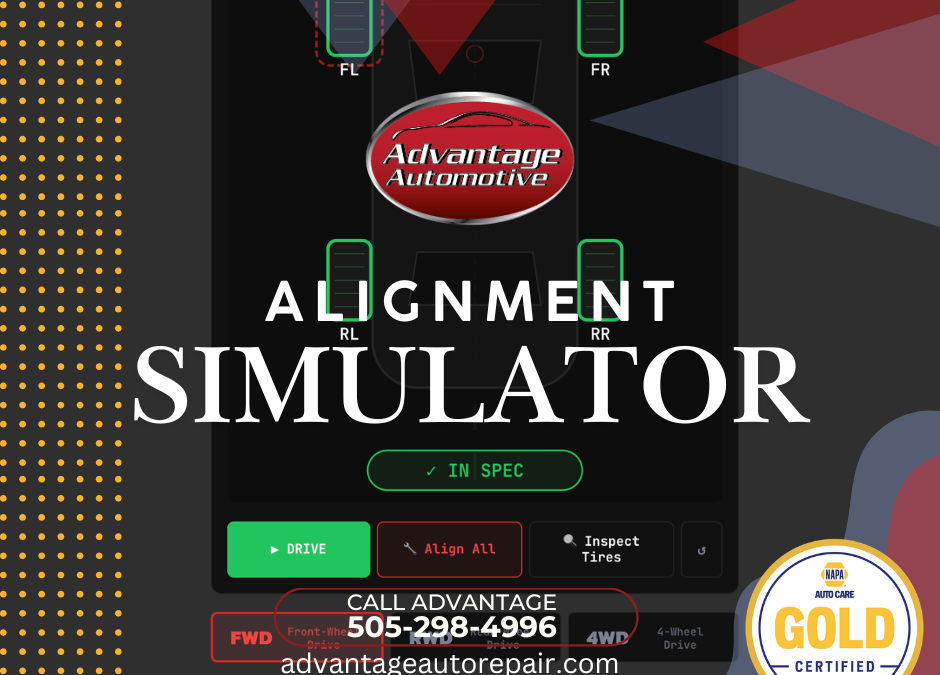
Most drivers do not think about wheel alignment until something feels wrong. Maybe the steering wheel pulls to the right when driving in Albuquerque, or maybe your last vehicle inspection points out that the inside edges of the front tires are completely bald while the outside edges still look new. By that point, the damage is already done. Alignment is one of those quiet maintenance items that saves real money when it is handled on time and costs real money when it is ignored.
- Misalignment wears tires unevenly and can cut their lifespan in half, turning a minor adjustment into a costly set of replacements
- Three angles control how your tires meet the road, and each one affects wear patterns, handling, and fuel economy differently
- Our interactive alignment simulator lets you see exactly how each angle works and what happens when things go wrong, before you ever set foot in the shop
Wheel Alignment Simulator
Even Wear
Tread is wearing evenly. Alignment is correct.
Noticing uneven wear or pulling?
Advantage Automotive uses precision Hunter alignment equipment to protect your tires and keep you safe on I-40 and I-25.
Schedule Alignment Check →Try It Yourself: The Alignment Simulator
We built an interactive alignment simulator so you can see these concepts for yourself instead of just reading about them. You do not need to be a mechanic to use it. Here is how to walk through it step by step.
Step 1: Choose your drivetrain. At the top of the simulator, select Front-Wheel Drive, Rear-Wheel Drive, or 4-Wheel Drive. This determines which wheels are powered, which affects how alignment issues show up in real driving.
Step 2: Explore the angles. Select any wheel by clicking it on the vehicle diagram, then use the sliders to adjust Toe, Camber, and Caster. Watch how the wheel rotates and tilts in the top-down view as you move each slider. The green range on each slider shows factory spec. Push a slider into the red zone and notice how the vehicle status changes to Out of Spec.
Step 3: Attach the alignment machine. On the right side, click each wheel to attach a sensor target, then power on the machine. This simulates the same process a technician follows in the shop. The live readout shows bar gauges for every angle on every wheel, with Pass or Adjust status for each one.
Step 4: Simulate road damage. Use the event buttons to see what happens when you hit a curb, when steering starts pulling, or when new tires are installed on a misaligned vehicle. Each event shifts specific angles and lets you see the immediate effect on the alignment readings.
Step 5: Drive and watch the wear. Press the Drive button and let the miles accumulate. If the angles are out of spec, tire wear accelerates visibly. Click Inspect Tires to open the tread cross-section view, which shows exactly where the tread is wearing down and diagnoses the wear pattern. You can see how inner edge wear comes from negative camber, how both-edge wear comes from excessive toe, and how a properly aligned wheel wears slowly and evenly.
Step 6: Fix it and compare. Click Align All to bring every wheel back to factory spec, then drive again. Compare how evenly the tires wear when alignment is correct versus how quickly damage accumulates when angles are off. That difference is the money alignment saves you.
How Three Angles Control Every Mile
Wheel alignment is not a single adjustment. It involves three separate angles on each wheel, and they all work together. Toe is the direction each wheel points when viewed from above. When toe is off, the tires scrub sideways against the pavement with every rotation. That scrubbing creates a feathered wear pattern you can feel by running your hand across the tread. Camber is the vertical tilt of the wheel when viewed from the front. When camber tilts too far inward, the inner edge of the tire carries most of the vehicle's weight and wears down fast while the outer edge stays nearly new. Caster is the angle of the steering axis. It does not wear tires as directly, but it controls how stable the vehicle feels at highway speed and whether the steering wheel returns to center after a turn.
When all three angles are within factory specifications, the full width of the tread makes even contact with the road. Weight is distributed properly, grip is consistent, and tires wear at the rate the manufacturer intended. When even one angle drifts out of spec, the tire contact patch shifts, and wear starts concentrating in one area. Over thousands of miles, that concentrated wear adds up fast.
What Knocks Your Alignment Out of Spec
Alignment does not just go bad on its own. Hitting a curb at speed, dropping into a pothole on Central or Rio Grande, or even minor fender contact can shift suspension components enough to throw angles out of range. Worn ball joints, tie rod ends, and control arm bushings also allow alignment to drift gradually over time. The tricky part is that misalignment usually does not announce itself with a warning light. It shows up as a slow pull to one side, a steering wheel that sits slightly off center, or tires that wear out thousands of miles earlier than expected.
New tires are another common trigger. Installing fresh rubber on a vehicle with existing alignment issues means the new tread starts wearing unevenly from the first mile. This is why alignment should be checked every time new tires are installed. The cost of an alignment check is a small fraction of the cost of replacing tires prematurely.
What Alignment Costs Versus What It Saves
A professional four-wheel alignment typically costs between $90 and $130. A full set of tires runs anywhere from $500 to $1,200 depending on the vehicle. When misalignment cuts tire life in half, that alignment check pays for itself several times over. Beyond tires, proper alignment also reduces strain on suspension components, improves fuel economy by reducing rolling resistance, and keeps the vehicle tracking straight for safer handling on I-40, I-25, and the winding roads through the Sandias.
The general recommendation is to have alignment checked once a year, any time new tires are installed, and after any significant impact like a hard pothole hit or curb strike. If the steering wheel is off center, the vehicle pulls to one side, or you notice uneven tire wear, those are signs alignment should be checked now rather than at the next scheduled interval.
Alignment is one of the most cost-effective maintenance services available. A few degrees of correction protects hundreds of dollars in tire investment and keeps your vehicle handling the way it was designed to. Try the simulator to see it for yourself, and when you are ready, bring your vehicle in for a professional alignment check.
Advantage Automotive
511 Paisano St NE, Albuquerque, NM
(505) 298-4996